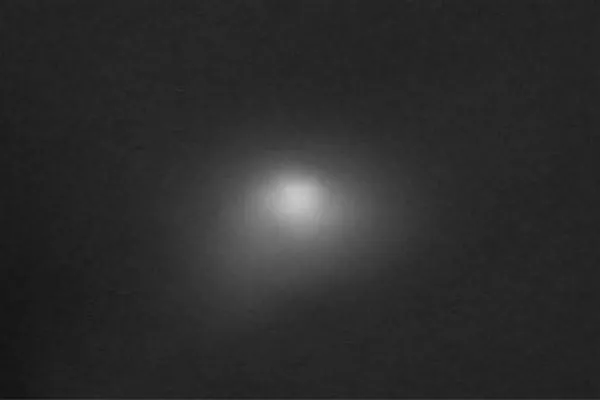
New image of 3I/ATLAS reveals its abnormal tail
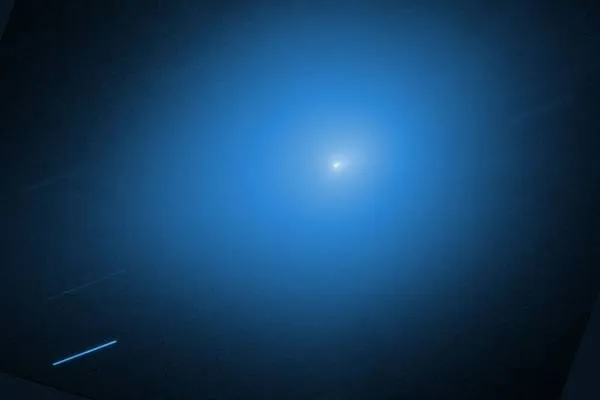
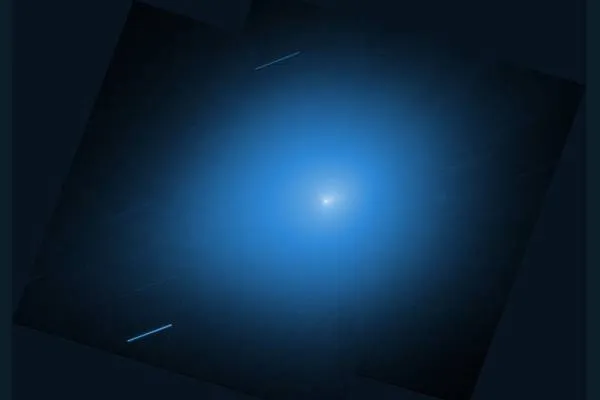
Istanbul, 2 December (Hibya) – A new image of the interstellar comet 3I/ATLAS, taken on 22 November by Japanese astronomer Koichi Itagaki, has revealed unprecedented features that have intrigued the scientific community. Detailed observations showed that the structure of the comet’s tail differs significantly from the patterns seen in comets originating in the Solar System.

Within the framework of Japan’s space-observation programme, the image taken with a 0.5-metre telescope revealed a remarkably broad and diffuse dust tail that stands in stark contrast to an almost imperceptible, point-like ion tail. According to Japanese scientists, this unusual morphology indicates that the third interstellar visitor detected so far has a different composition and origin, providing valuable data about the formation of other stellar systems.
Meanwhile, analysis of comet 3I/ATLAS is ongoing in research groups around the world. Preliminary findings suggest that the comet’s properties may redefine current models of the composition of small celestial bodies travelling through deep space and may serve as a natural probe of their parent systems.
Analysis of the image taken by Itagaki shows that the dust tail of 3I/ATLAS is composed of extremely fine particles. Scientists describe this as follows: “This feature is atypical, because comets in our Solar System usually eject coarser dust grains that interact with sunlight in a different way,” and they go on to explain:
“This fine dust may indicate that the comet formed in an environment with very special conditions – perhaps in a region much farther from its parent star, or within a protoplanetary disk with a specific chemical composition. This observation challenges the assumption that comets across the galaxy share similar formation processes.”
“The data collected also suggest that the volatile material evaporating from the comet’s nucleus and carrying dust particles outward may contain a different proportion of gas than that found in local comets. Scientists are continuing to investigate the comet’s full chemical composition by searching for spectral signatures that could reveal more about its origin.”
According to the Japanese researchers, the main observed features that distinguish 3I/ATLAS are:
- an almost point-like, weak and compact ion tail;
- an extremely wide and diffuse dust tail composed of very small particles;
- a nucleus that remains bright and point-like even as the coma expands.
Scientists say that, in addition to the tail, the nucleus of comet 3I/ATLAS and the surrounding atmosphere (coma) also display some peculiarities. The nucleus appears very compact and solid, reflecting sunlight intensely, almost like an asteroid:
“However, it is clearly active, since it releases gas and dust that form an expanding coma, which definitively classifies it as a comet. This duality between an apparently solid nucleus and strong cometary activity is one of the main focuses of the study.”
Astronomers also point out that this gas-emission activity appears to be the driving force behind the formation of the unusual dust tail. They hypothesise that solar heating may be activating extremely cold volatile substances that are not commonly seen in comets in our own system.
For this reason, the way the coma developed as it approached the Sun was different from that of the second known interstellar visitor, 2I/Borisov, which displayed more predictable behaviour resembling that of familiar comets – further reinforcing the uniqueness of 3I/ATLAS.
Europe Asia News
 Facebook
 Tweeter
 Whatsapp